


The Stressinsight Pressure Pathway: Understanding How Pressure Gradually Becomes Stress
Stress is often explained one piece at a time.
Some articles describe the biology of the stress response. Others focus on recovery, resilience, burnout, or workplace wellbeing. Each contributes valuable insights, but seeing how these concepts fit together is often more difficult.
The Stressinsight Pressure Pathway was developed to connect these concepts within a single biological framework. It explains how pressure activates the body's stress response, how adaptation normally restores balance, why recovery completes the adaptive process, and how repeated incomplete adaptive cycles gradually influence concentration, motivation, performance, and eventually the risk of burnout.
The framework deliberately begins with pressure rather than stress. Pressure represents the demands placed upon us, whether they arise from work, family life, illness, financial concerns, or other life circumstances. Stress is the adaptive biological response that allows us to respond to those demands.
Understanding how pressure gradually develops into stress provides a different way of looking at wellbeing. Rather than focusing only on symptoms once they become obvious, the Pressure Pathway helps explain how changes in functioning develop over time and where opportunities exist to recognise them much earlier.
Although many examples throughout Stressinsight come from the workplace, the same biological principles apply to almost every situation in which people repeatedly adapt to changing demands.
Key Takeaways
- The Pressure Pathway brings together the biological concepts that explain how sustained pressure gradually changes functioning.
- Pressure activates the stress response, allowing the body and mind to adapt to changing demands.
- Healthy adaptation restores homeostasis and includes recovery, which replenishes the resources used during adaptation.
- Incomplete recovery and chronic stress represent two different ways in which adaptive cycles may remain incomplete.
- Repeated incomplete adaptive cycles gradually increase allostatic load, helping explain changes in concentration, motivation, performance, and wellbeing.
The Stressinsight Pressure Pathway
Life constantly places demands on the body and mind.
Meeting a deadline, preparing a scientific presentation, caring for a child, recovering from illness, resolving a conflict, or adapting to an unexpected change all require the body to respond. Although these situations differ enormously, they activate many of the same biological systems that allow us to adapt while maintaining stable internal conditions.
Physiologists refer to this stability as homeostasis.
Whenever homeostasis is disturbed, the body activates a coordinated stress response. Stress hormones, the autonomic nervous system, the immune system, metabolism, and many brain networks work together to redistribute energy and other resources towards the systems most directly involved in responding to the current challenge. Our article Stress Is All About Energy in the Body explains this redistribution of resources in greater detail.
The coordinated physiological and psychological adjustments that restore stability are known as allostasis. Together, the stress response and allostasis allow us to adapt to changing demands while continuing to function effectively.
Most of the time, this adaptive system works remarkably well.
The Pressure Pathway describes what happens next.
Figure 1 — The Stressinsight Pressure Pathway
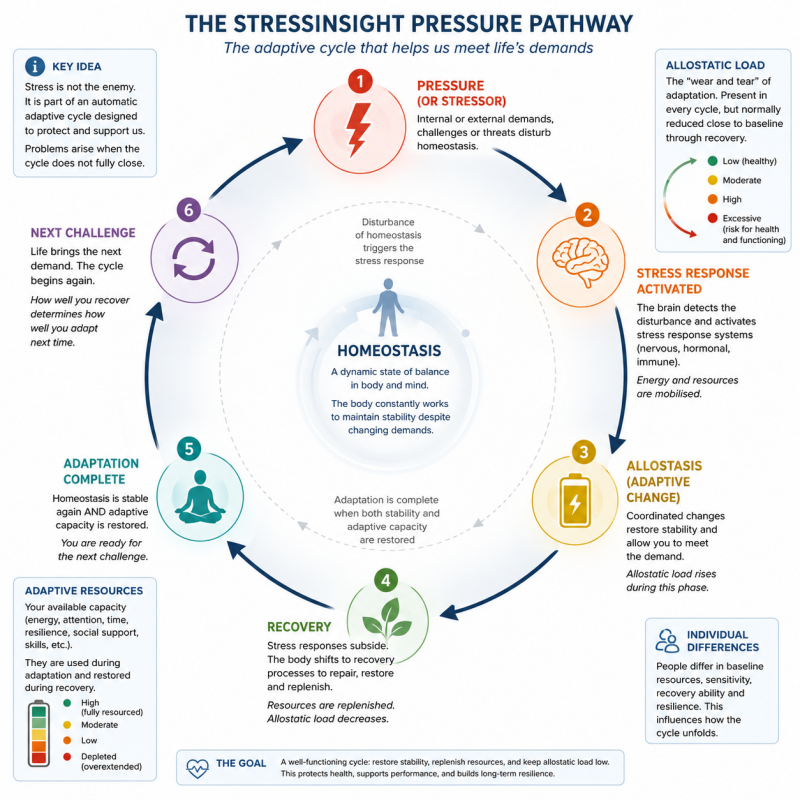 The figure illustrates three possible outcomes of an adaptive cycle. Each begins with pressure disturbing homeostasis and activating the body's stress response. The difference lies in whether homeostasis and recovery are successfully completed before the next challenge occurs.
Healthy Adaptation
In the healthy adaptive cycle, pressure temporarily disturbs homeostasis and activates the body's stress response.
Stress hormones and the autonomic nervous system rapidly coordinate physiological and psychological adjustments that help the body respond to the current challenge. At the same time, energy and other biological resources are redistributed towards the organs and brain systems most directly involved in meeting the demands of the situation. Depending on the nature of the challenge, this may involve increasing physical readiness, sharpening attention, supporting complex thinking, or maintaining concentration during cognitively demanding work.
These coordinated adjustments are collectively known as allostasis.
As the challenge is resolved, homeostasis is gradually restored and activation of the stress response begins to subside. Recovery then replenishes the energy and other biological resources that were consumed during adaptation, preparing the body and mind for future demands.
One of the central ideas of the Pressure Pathway is that adaptation is only complete once recovery has replenished the resources used during adaptation. Homeostasis has been restored, adaptive capacity has been renewed, and the organism is ready for the next challenge.
This healthy adaptive cycle repeats throughout life, allowing us to respond to changing demands while maintaining relatively stable physical and psychological functioning.
Our articles on The Definition of Stress According to Science, Stress Is All About Energy in the Body, Ending Stress: Switching Off Cortisol, and How to Stop Your Adrenaline Rush explore these individual biological processes in greater depth.
Incomplete Recovery
The second pathway follows the same biological sequence until homeostasis has been restored.
The difference is that recovery remains incomplete. Although the stress response has largely subsided and normal functioning appears to have returned, the energy and other biological resources consumed during adaptation have not yet been fully replenished.
The next adaptive cycle therefore begins with a smaller physiological reserve than the previous one.
Within the Pressure Pathway, the adaptive cycle has not yet reached its natural conclusion. Although homeostasis has been restored, adaptive capacity has only been partially replenished. Individually, these changes may be barely noticeable. Across repeated cycles, however, incomplete recovery gradually increases allostatic load and reduces the resources available to respond to future challenges.
This helps explain why people often continue functioning successfully while gradually noticing subtle changes in concentration, motivation, creativity, emotional regulation, or performance.
Chronic Stress
The third pathway follows a different course.
Here, the original source of pressure continues disturbing homeostasis. Because physiological stability has not yet been restored, the body continues activating stress responses in an ongoing attempt to re-establish balance.
Energy and other biological resources therefore continue to be directed towards coping with the challenge. Recovery cannot fully begin because the adaptive response itself has not yet been completed.
Within the Pressure Pathway, the adaptive cycle remains interrupted before homeostasis has been restored. As long as the underlying source of pressure continues, stress responses remain active, allostatic processes continue demanding resources, and allostatic load remains elevated.
Although chronic stress and incomplete recovery arise through different biological mechanisms, both gradually reduce adaptive capacity and increase physiological strain over time.
Figure 2 — Homeostasis During Three Adaptive Cycles
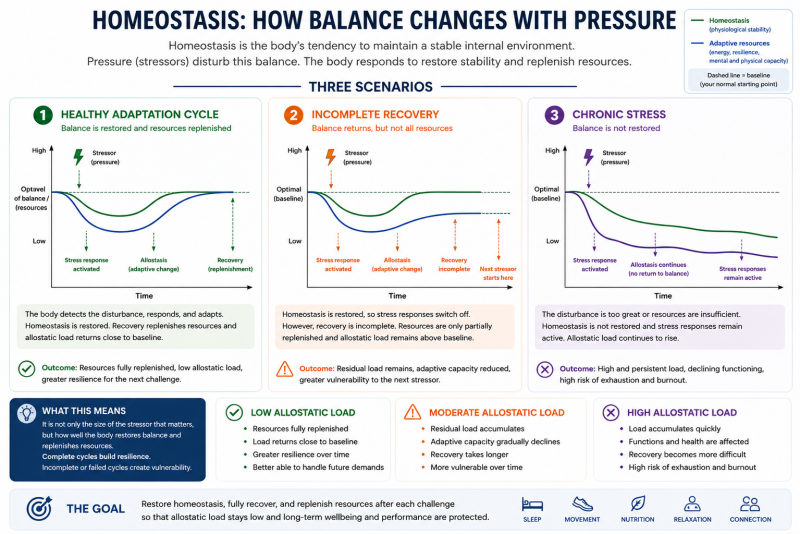 Figure 2 illustrates how homeostasis changes during each of the three adaptive pathways. The biological processes involved are similar in every cycle, but the extent to which homeostasis and recovery are achieved determines how well the body is prepared for future challenges.
Healthy Adaptation
In the healthy adaptive cycle, pressure temporarily disturbs homeostasis and activates the body's stress response. The physiological adjustments involved in allostasis gradually restore stability while the challenge is being addressed.
Once homeostasis has been re-established, activation of the stress response gradually subsides. Recovery then replenishes the energy and other biological resources that were used during adaptation.
Within the Pressure Pathway, this represents a completed adaptive cycle. Homeostasis has been restored, adaptive capacity has been replenished, and the organism is ready to respond effectively to the next challenge.
Incomplete Recovery
The second graph illustrates a different outcome.
Here, homeostasis is restored and the stress response largely subsides. From the outside, the individual may therefore appear to have recovered.
Recovery, however, remains incomplete. Some of the energy and biological resources consumed during adaptation have not yet been fully replenished before the next source of pressure appears.
The following adaptive cycle therefore begins with a smaller physiological reserve than the previous one. Although each individual challenge may still be managed successfully, repeated cycles of incomplete recovery gradually reduce adaptive capacity while increasing allostatic load.
Within the Pressure Pathway, this means that the adaptive cycle has not yet been fully completed. The biological cost of adaptation remains partly unresolved, making future challenges progressively more difficult to accommodate.
Chronic Stress
The third graph follows a different biological pathway.
Here, the original source of pressure continues disturbing homeostasis. Because physiological stability has not yet been restored, stress responses remain active while allostatic processes continue attempting to re-establish balance.
Energy and other biological resources therefore continue to be directed towards coping with the ongoing challenge. Recovery cannot fully begin because the adaptive response itself has not yet reached its natural conclusion.
Within the Pressure Pathway, the adaptive cycle remains interrupted before homeostasis has been restored. As long as the underlying source of pressure persists, stress responses continue demanding physiological resources and allostatic load remains elevated.
Although chronic stress and incomplete recovery develop through different biological mechanisms, both gradually reduce adaptive capacity and influence functioning over time.
Figure 3 — How Allostatic Load Changes Over Time
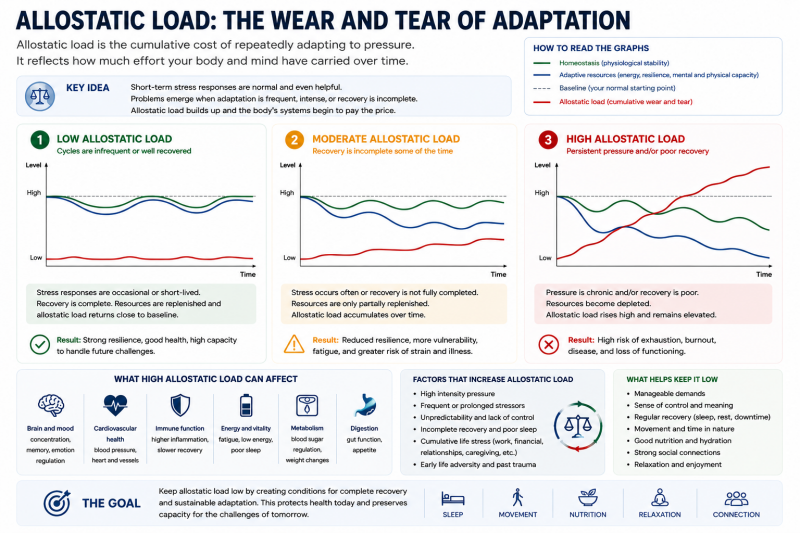 Every adaptive cycle carries a biological cost. Figure 3 illustrates how this cost, known as allostatic load, changes over repeated adaptive cycles.
Low Allostatic Load
In healthy adaptation, allostatic load rises temporarily while the body responds to a challenge before returning close to its usual baseline as recovery is completed.
These temporary fluctuations are a normal part of healthy physiology. They allow people to adapt repeatedly to changing demands without progressively increasing physiological strain.
Within the Pressure Pathway, repeated healthy adaptive cycles maintain a low allostatic load because both homeostasis and adaptive capacity are restored before the next challenge occurs.
Moderate Allostatic Load
When recovery repeatedly remains incomplete, allostatic load no longer returns fully to baseline before the next adaptive cycle begins.
Each new challenge therefore starts with a slightly greater physiological burden than the previous one. Individually, these changes may appear small. Across weeks or months, however, they gradually reduce physiological reserve while increasing the effort required to adapt successfully.
Within the Pressure Pathway, this reflects repeated adaptive cycles that consistently reach homeostasis but only partially restore adaptive capacity.
High Allostatic Load
When homeostasis cannot be restored or adaptive cycles repeatedly remain incomplete, allostatic load continues to accumulate.
Eventually, maintaining normal functioning requires progressively greater physiological effort. Concentration becomes more difficult, recovery slows, emotional regulation becomes less flexible, and performance may gradually begin to decline despite continued commitment and effort.
Our article Why Performance Declines Before Burnout: Understanding Allostatic Load explores these longer-term consequences in greater detail.
What the Pressure Pathway Helps Explain
Once the Pressure Pathway is understood, many experiences associated with stress become easier to understand.
Rather than viewing concentration problems, declining motivation, slower recovery, overwhelm, or burnout as separate issues, the framework shows how they can emerge from different stages of the same adaptive process.
The pathway therefore provides a biological context for many of the topics explored throughout Stressinsight.
Why Performance Can Change Before Burnout
Performance often begins changing long before exhaustion becomes visible.
When adaptive cycles repeatedly remain incomplete, physiological and psychological resources become progressively more difficult to mobilise. People may continue meeting deadlines, solving problems, and fulfilling responsibilities while concentration, creativity, cognitive flexibility, and decision-making gradually become less efficient.
Viewed through the Pressure Pathway, these changes reflect the gradual consequences of adaptive cycles that are no longer being fully completed.
Read more in Why Performance Erodes Long Before Burnout Appears.
Why Motivation Gradually Changes
Motivation is closely linked to the brain systems involved in effort, reward, and goal-directed behaviour.
As adaptive resources become more difficult to replenish, maintaining initiative and sustained mental effort requires progressively greater physiological investment. Activities that once felt engaging may therefore begin to feel mentally demanding, even though the underlying interest in the work itself has not necessarily changed.
The Pressure Pathway helps place these changes within the broader process of adaptation rather than viewing them as isolated psychological symptoms.
Read more in Stress and Motivation: Why Sustained Pressure Gradually Reduces Drive.
Why Overwhelm Can Seem to Appear Suddenly
Many people describe overwhelmas though it appeared overnight.
The Pressure Pathway suggests a more gradual process.
Adaptive capacity may already have been progressively reduced through repeated incomplete cycles before one additional demand exceeds the resources that remain available.
The final challenge is therefore often the one people remember, even though the biological process began much earlier.
Why Some Sources of Pressure Become Chronic
The Pressure Pathway also helps explain why certain forms of pressure become particularly persistent.
When the underlying source of pressure continues disturbing homeostasis, the adaptive cycle cannot be completed. Stress responses therefore remain activated because the body continues attempting to restore stability.
Examples include prolonged uncertainty, unresolved conflict, chronic illness, caregiving responsibilities, or working in environments where demands consistently exceed the available resources.
Viewed through the Pressure Pathway, these situations differ from incomplete recovery. The challenge itself remains present, making it difficult for recovery to fully begin until the underlying source of pressure has changed.
Why People Respond Differently to the Same Pressure
The Pressure Pathway describes a biological process that is common to everyone.
People nevertheless differ considerably in how easily they move through that pathway.
Factors such as genetics, previous life experiences, personality, physical health, sleep, social support, coping strategies, opportunities for recovery, and the environments in which people live and work all influence how successfully adaptive cycles are completed.
Two people may therefore experience the same source of pressure while following different trajectories through the pathway. One may complete each adaptive cycle successfully, while another is more likely to experience incomplete recovery or eventually develop chronic stress.
The pathway itself remains unchanged. What differs is the likelihood of successfully completing each adaptive cycle.
Understanding these individual differences also helps explain why the same source of pressure can affect people differently. The way adaptive cycles unfold depends on the interaction between the demands people face and the biological, psychological, and environmental resources available to respond to those demands.
Looking at Stress Through the Pressure Pathway
The Pressure Pathway brings together the biological processes that explain how sustained pressure gradually influences adaptation, recovery, functioning, and wellbeing over time.
Once this framework is understood, many experiences that initially appear unrelated—declining motivation, reduced concentration, slower recovery, overwhelm, performance changes, or eventually burnout—can be recognised as different expressions of the same underlying adaptive process.
Every major article on Stressinsight explores one part of this pathway. Together they describe how sustained pressure influences the body and mind. The Pressure Pathway provides the framework that connects these individual concepts into a coherent understanding of how stress develops over time.
Continue Exploring the Pressure Pathway
Understanding the Pressure Pathway is the first step towards recognising how sustained pressure may be influencing your own functioning or that of your organisation.
If you would like to better understand where you may currently be within the pathway, download the free guide Signs You're Under Too Much Pressure. If you're interested in applying the same principles within teams or organisations, visit the Business section of Stressinsight to learn how the Pressure Pathway can help identify the conditions that influence healthy adaptation and long-term performance.
FAQs
What is the StressInsight Pressure Pathway?
The Stressinsight Pressure Pathway is a biological framework that explains how sustained pressure activates the stress response, how adaptation and recovery normally restore balance, and how repeated incomplete adaptive cycles gradually influence functioning over time.
Is pressure always harmful?
No. Pressure is a normal part of life and is necessary for adaptation, learning, and growth. Problems generally arise when adaptive cycles repeatedly remain incomplete or when homeostasis cannot be restored.
Why is recovery part of adaptation?
Recovery replenishes the energy and biological resources that are consumed during adaptation. Within the Pressure Pathway, adaptation is only complete once both homeostasis and adaptive capacity have been restored.
What is the difference between incomplete recovery and chronic stress?
With incomplete recovery, homeostasis has been restored but adaptive capacity has not yet been fully replenished. In chronic stress, homeostasis itself cannot be restored, causing stress responses to remain activated for prolonged periods.
Why do people respond differently to the same pressure?
Everyone follows the same biological pathway, but factors such as personality, previous experiences, physical health, recovery habits, and environmental conditions influence how successfully adaptive cycles are completed.